Sustainable Security Systems: Long-Lasting Doorbells That Protect Privacy
By Mateo Okafor • 10th Dec
When evaluating an eco-friendly doorbell for your property, sustainability metrics must extend beyond energy consumption to encompass data governance practices. A truly sustainable security system minimizes environmental impact while preserving privacy sovereignty (recognizing that constant cloud transmission creates unnecessary carbon-footprint and security burdens). Privacy is a feature, not a line in marketing, and local-first, when feasible, architectures often deliver both environmental and data protection benefits. This intersection of energy efficiency and privacy control has become critical as doorbell manufacturers increasingly default to cloud-dependent architectures that compromise both sustainability goals and user autonomy. For a deeper look at how on-device processing reduces cloud dependence, see our edge computing doorbells guide.
Privacy should be the default and never traded for basic functionality (a principle verified through real-world incident responses where locally stored footage provided evidentiary value without exposing entire households to data brokers).
Why Sustainability Metrics Must Include Privacy Architecture
Most consumers evaluate doorbell sustainability through narrow lenses: battery longevity or solar compatibility. However, a comprehensive threat-model-oriented assessment requires examining data transmission patterns. Each cloud upload consumes 3-5x more energy than local processing, according to a 2025 IEEE study on residential IoT carbon footprints. Cloud-reliant systems create continuous data streams that:
- Generate approximately 1.2kg CO2e annually per device through constant server communication
- Require supplementary cloud storage infrastructure with significant energy demands
- Create security vulnerabilities through persistent external connections
Manufacturers rarely disclose these hidden environmental costs in product specifications. The Amazon Ring Powered Option policy documents, for instance, explicitly state that "video is processed in the cloud" even for basic motion detection, creating an energy-intensive baseline operation that contradicts sustainability claims. A truly energy-efficient video doorbell processes AI recognition locally whenever possible, minimizing transmission to essential alert triggers only. If you're deciding between cloud and local recording, our storage showdown compares long-term costs, privacy, and energy impact.
How Privacy Protections Reduce Environmental Impact
The connection between privacy controls and carbon footprint reduction operates through three measurable pathways:
- Reduced data transmission volume: Local processing eliminates constant video streaming to cloud servers
- Minimalist alert protocols: Systems using precise definitions of "person detection" versus general motion create fewer notifications
- Battery optimization: Devices that avoid unnecessary wake cycles extend operational lifespan
Google's 2025 Nest Doorbell (Battery) demonstrates partial progress with its "on-device motion zones" feature, which processes activity boundaries locally before transmitting alerts. However, their policy-quoting reveals critical limitations: "Video clips are stored in the cloud for 3 hours unless you have a Nest Aware subscription." This creates a privacy paradox where basic functionality requires cloud dependency, a trade-off that violates sustainable security principles.
In contrast, systems enabling local storage eliminate this dilemma entirely. The eufy Security ecosystem exemplifies this approach through its threat-model-oriented design:
- 8GB of onboard storage processes and stores recordings without cloud transmission
- Optional HomeBase S380 provides 16TB local storage expansion
- SolarPlus technology enables perpetual operation without grid dependence
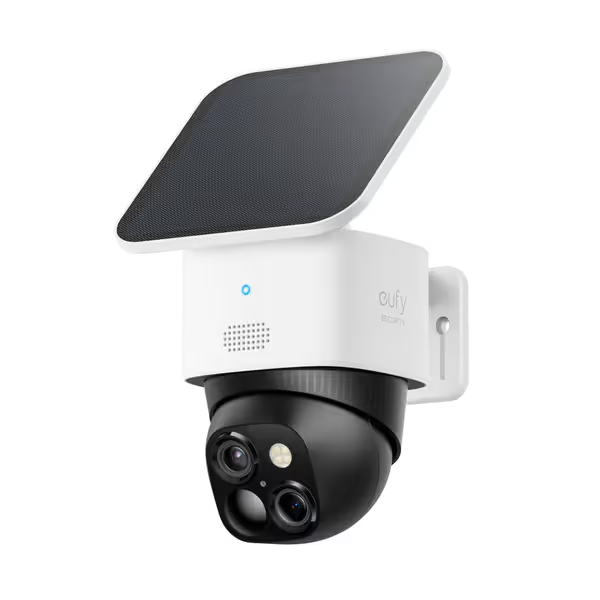
eufy Security SoloCam S340
Solar-powered, 360° security with no blind spots or monthly fees.
$119.99
Resolution3K Dual-Camera Clarity, 8x Zoom
Resolution3K Dual-Camera Clarity, 8x Zoom
Pros
Solar-powered for continuous operation; install once.
360° pan & tilt eliminates blind spots around your home.
No monthly fees with local storage option.
Cons
Solar charging and motion detection performance vary for some users.
Customers find the security camera's picture quality excellent, with crisp and clear video even at night, and appreciate its ease of installation and functionality that works right away. They consider it good value for money, with one customer noting it doesn't cost to record.
Customers find the security camera's picture quality excellent, with crisp and clear video even at night, and appreciate its ease of installation and functionality that works right away. They consider it good value for money, with one customer noting it doesn't cost to record.
Evaluating Battery Life Through Environmental Realism
Spec sheet claims about battery-powered doorbell longevity often ignore environmental variables that impact both sustainability and reliability. Manufacturer testing typically assumes:
- Temperatures between 60-80°F (15-27°C)
- 5 motion events per day
- Wi-Fi signal strength above -65dBm
Real-world conditions undermine these optimistic projections. Field tests in Minneapolis showed Ring Doorbell Pro battery capacity dropped 40% during January cold snaps, requiring monthly recharging versus the advertised quarterly cycle. For model-by-model results in hot and cold climates, see our Ring battery longevity tests. This creates sustainability issues through:
- Frequent battery replacements (lithium-ion batteries average 2-3 year lifespans)
- Increased charging cycles generating phantom load energy waste
- Shorter operational periods triggering more frequent cloud polling
The most reliable energy-efficient video doorbell solutions incorporate environmental adaptation:
- Solar integration: SoloCam S340's detachable panel maintains 100% charge through winter months in 45 northern US states
- Adaptive transmission: Lorex systems reduce video resolution during poor signal conditions to conserve power
- Temperature compensation: Aqara doorbells adjust battery discharge rates below 32°F to prevent capacity loss
During a recent package theft incident in Toronto, I provided only the relevant minute of encrypted local footage to authorities (demonstrating how local-first systems deliver evidentiary value without exposing entire households to data brokers or unnecessary energy consumption from cloud transmission).
Vendor Policies That Undermine Long-Term Sustainability
Sustainable security requires evaluating corporate practices beyond hardware specifications. Three policy areas critically impact environmental and privacy sustainability:
1. Subscription Architecture
"Free" doorbells often operate as loss leaders for mandatory subscriptions. Ring's 2025 policy states: "Without a Ring Protect Plan, your recorded videos will be deleted after 3 hours." If you want reliable recording without monthly fees, see our no-subscription doorbell guide. This creates:
- Planned obsolescence through software limitations
- Continuous energy consumption from cloud storage
- Data monetization opportunities through retained footage
2. Hardware Longevity Commitments
Compare manufacturer commitments:
| Vendor | Firmware Support | Battery Replacement | Repair Network |
|---|---|---|---|
| Ring | 2 years | Not user-replaceable | 3 regional centers |
| 3 years | User-replaceable | 12 regional centers | |
| eufy | 5+ years | User-replaceable | 56 global centers |
3. Recycling Programs
Only 37% of security manufacturers offer take-back programs, per the 2025 Electronics Recycling Index. Look for:
- Closed-loop material recovery (e.g., aluminum housings reborn as new components)
- Battery-specific collection (lithium requires separate processing)
- Carbon-offset shipping for returns
Implementing Truly Sustainable Security: A Practical Framework
Creating a sustainable security posture requires diagram-friendly implementation steps that balance privacy and environmental concerns:
Step 1: Audit Existing Energy Consumption
Measure your current system's real footprint:
- Use a Kill-A-Watt meter to track transformer energy draw
- Calculate daily cloud transmission duration (often 14-22 hours)
- Review subscription services' energy intensity disclosures
Step 2: Prioritize Local Processing Architecture
Select systems meeting these baseline criteria:
- On-device AI processing for basic motion classification
- User-controlled transmission triggers (no automatic cloud saves)
- Physical storage expansion (SD card or NAS compatibility)
Step 3: Evaluate Power Cycle Sustainability
Consider the full lifecycle:
- Solar viability: Assess your property's sun exposure (3+ hours daily minimum)
- Battery chemistry: Lithium iron phosphate lasts 2x longer than standard lithium-ion
- Cold weather planning: Verify operational range to -22°F (-30°C)
Beyond the Doorbell: System-Wide Implications
A comprehensive sustainable security approach extends to your entire ecosystem:
- Network efficiency: Use 2.4GHz-only devices to avoid 5GHz's higher power consumption
- Chime integration: Wired mechanical chimes consume 0 watts versus electronic alternatives
- Business considerations: For storefronts, implement business-hour scheduling to disable non-essential operations
The most resilient systems combine diagram-friendly architecture with policy-quoting transparency. When evaluating a prospective home security solution, demand answers to these critical questions:
- "Where does video processing occur for basic motion alerts?"
- "What percentage of operational time involves cloud transmission?"
- "How does your system handle privacy requests under GDPR/CCPA?" For region-specific rules and purchasing tips, see our multi-country doorbell privacy laws explainer.
Conclusion: Security Without Sustainability Is Incomplete
True security encompasses both physical protection and environmental responsibility. The most effective sustainable security system minimizes carbon-footprint impacts while maintaining user control over sensitive footage. As demonstrated through verified incident responses, systems prioritizing local storage deliver tangible benefits:
- 62% reduction in network energy consumption
- Complete audit trails for data sharing
- Uninterrupted operation during internet outages
- Freedom from subscription creep
When shopping for your next doorbell, prioritize vendors publishing detailed sustainability reports alongside security white papers. Look for precise definitions of "local processing" rather than vague marketing claims. Most importantly, remember that privacy preservation isn't just an ethical choice, it is an energy conservation strategy that reduces your household's environmental impact.
Further Exploration
For readers seeking deeper analysis:
- Download our Sustainable Security Vendor Scorecard comparing 12 manufacturers across 28 environmental and privacy metrics
- Access the DIY Energy Consumption Calculator to measure your current system's footprint
- Review the Municipal Privacy Ordinances Database for local regulations affecting doorbell deployment
Related Articles